
The Slowest Part of an Agent Loop Is the Agent Working Blind
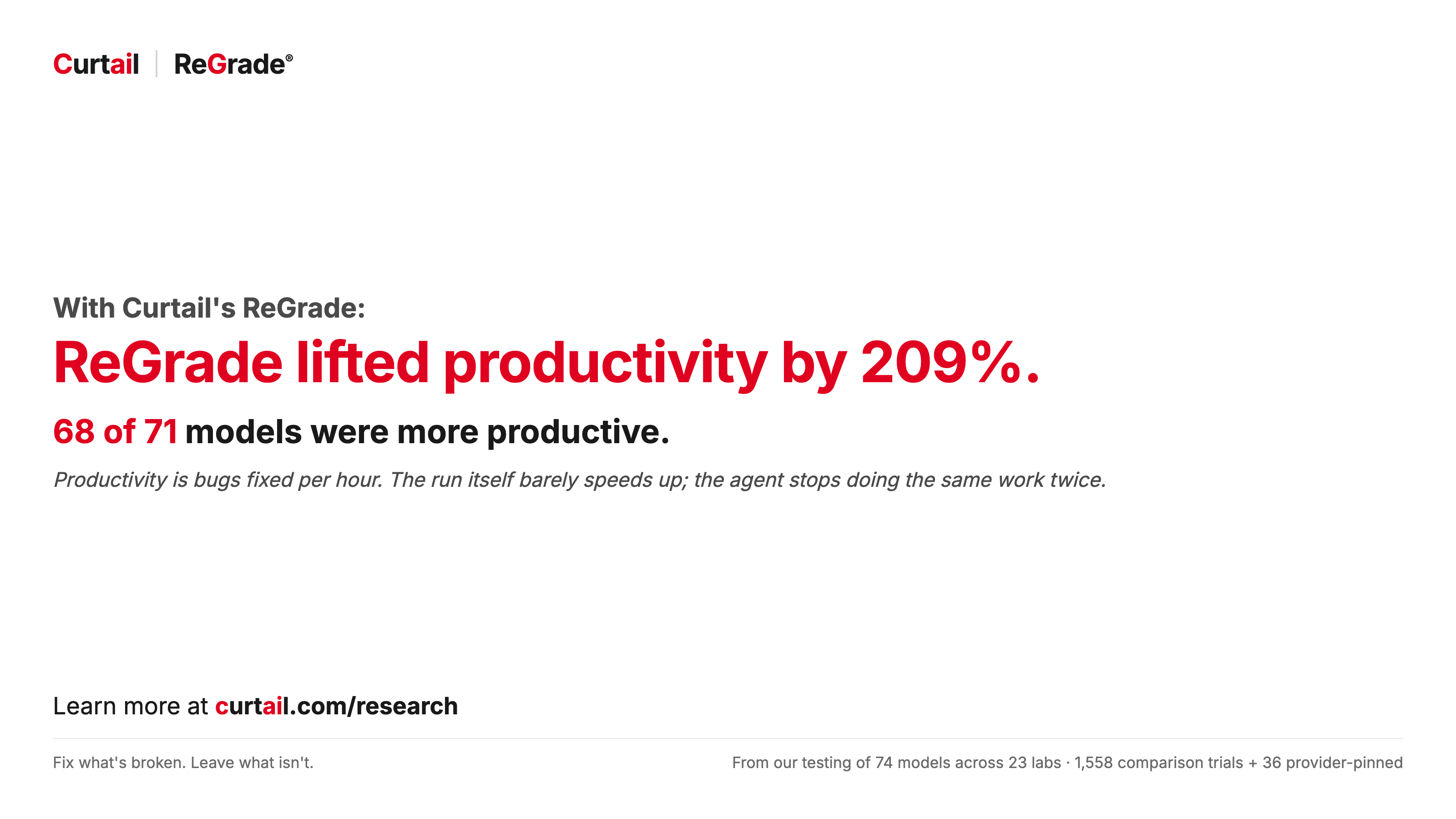
Productivity rose 209% with a behavioral diff in the loop, on 68 of 71 models. The run barely sped up; the agent stopped doing the same work twice.
A coding agent working without a behavioral diff spends most of its turns finding out what it already did.
We measured that. Productivity, meaning bugs fixed per hour, rose 209.9% with ReGrade® in the loop, on 68 of the 71 models we could time. The same measurement stated the other way up: time per bug fixed fell 67.7%.
Most of it is not raw speed
A single run with ReGrade is faster, but nowhere near enough to explain the headline: 19% faster at the median, and still slower on 26 of the 72 models we timed.
Put those together. Runs got a little quicker while output per hour more than tripled. The gap between those two numbers is the whole point: the agent is not thinking faster so much as spending its turns on work that lands.
Where the time goes
Unaided, a turn is often reconnaissance. Read the file again. Run the tests again. Grep for the caller. Each of those is a full round trip, and the agent is rebuilding context it had two turns ago.
With a behavioral diff in the prompt, that reconnaissance is already answered. Ant Group's Ling 2.6-1T is the sharpest example we have: its treatment runs finished in well under half the wall-clock of its control runs, at 193 seconds against 446, while fixing more.
Three models got slower
DeepSeek V4-flash-0423 is the worst, at about a third more time per fix. Gemini 3.1 Pro Preview and Qwen3-Coder also took longer per fix. All three fixed more bugs with the diff than without it, but their runs grew longer by more than their fix counts rose.
Two of those three, Gemini 3.1 Pro Preview and Qwen3-Coder, are also among the three that came out more expensive per fix. For both, the extra fixes did not keep pace with the longer runs.
What this is measured against
Bugs fixed per hour, not runs per hour. Bugs actually fixed from the trial record, divided by wall clock, per model, then compared across arms. It is the reciprocal of time per bug fixed, and we report it this way because it answers what an engineering budget asks: what did the hour buy.
Wall clock is noisy. It moves with provider load, routing and how many other jobs are on the machine, and we ran these over several days. Treat the direction and the magnitude as sound, and any single model as approximate. The cost figures are steadier, because tokens do not care how busy a provider is.
What to take from this
If your agent loop feels slow, the instinct is to reach for a faster model. On this evidence the bigger lever is cutting the work the agent does twice.
Fewer turns spent rediscovering the last change means fewer turns overall, and the time you get back scales with how much rework your loop was doing in the first place.