
Your Agent's Bill Is Not the Problem. Your Cost Per Fix Is.
A behavioral diff makes each agent run spend about 30% more tokens. It makes each bug fixed cost 58% less. Only one of those is what you buy.
Adding ReGrade® to an agent loop makes each run spend about 30% more tokens. Only 27 of the 72 models we measured ran leaner per run.
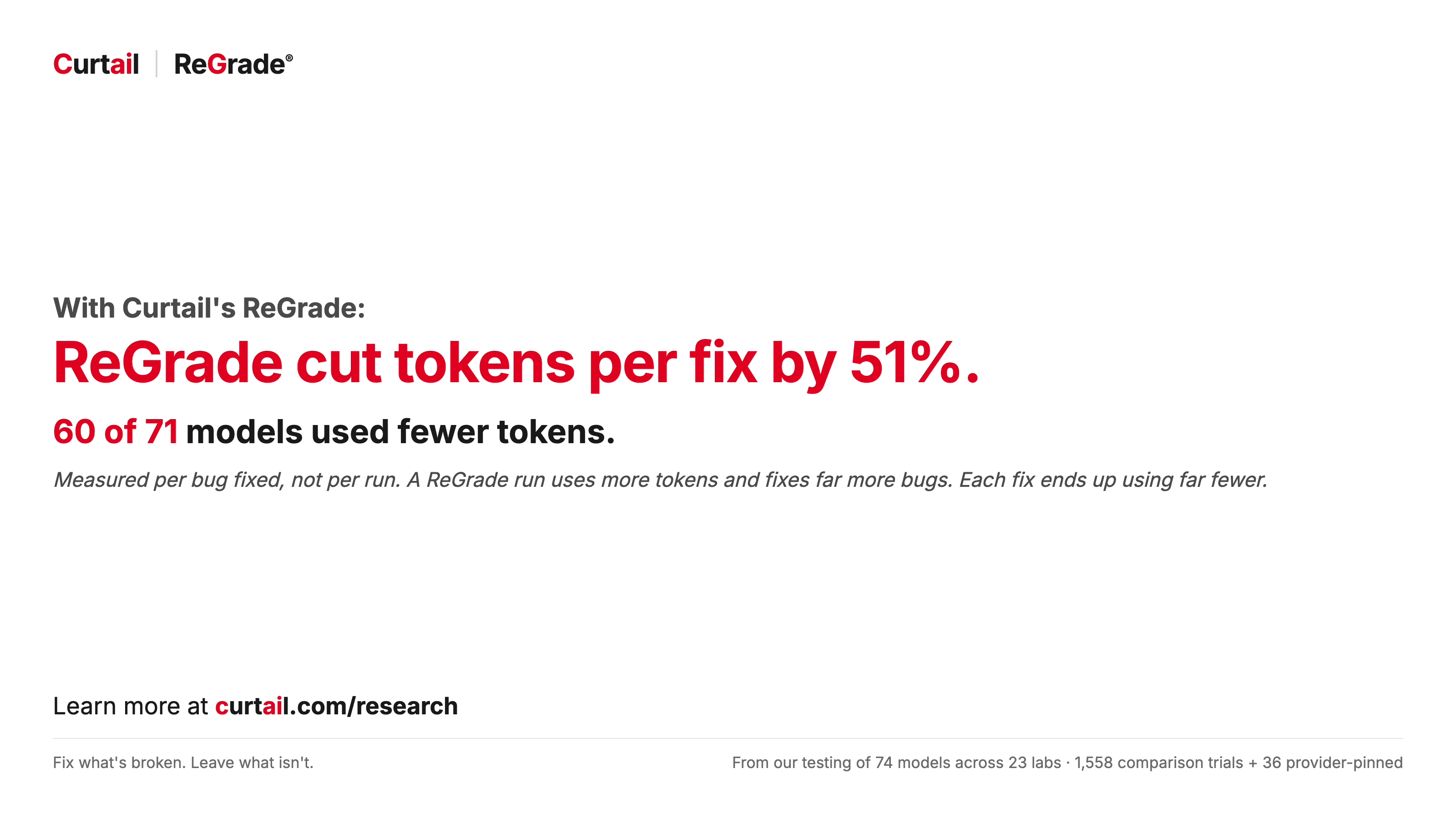
We are opening with that because it is the honest place to start, and because the number people quote back at us is the other one: tokens per bug fixed fell 51%.
Both are true. They are the same measurement with different denominators, and only one of them is what you actually buy.
Why a run costs more
ReGrade puts a behavioral diff in the prompt. That is more input tokens on every turn, and input tokens are billed. On the typical model a run spent 30% more tokens. 27 of the 72 models still ran leaner per run. The other 45 did not, and we would not believe a benchmark that said every run gets cheaper.
Why the typical fix costs less
The agent fixes far more bugs with the diff than without it. Across the priced models, unaided runs averaged 6.6 fixes and ReGrade runs averaged 14.7.
Divide by the fixes and the economics invert. Median tokens per bug fixed fell 51.1%, on 60 of the 71 models we could measure. In dollars, at the rate each provider billed, median cost per bug fixed fell 58.5% on 61 of the 64 models we could price. We report tokens on the card because a token count does not go stale when a vendor reprices.
Some of the moves are large. Ling 2.6-1T went from $0.087 a fix to $0.006. Qwen3.6-Max-preview went from $0.336 to $0.036. Haiku 4.5 (Aug 2026) went from $0.145 a fix to $0.047, because it fixed five times as many bugs.
3 models got more expensive
Gemini 3.1 Pro Preview is the worst of them: its cost per fix rose 25.7%. Mistral Medium 3.5 rose 20.4% and Qwen3-Coder 8.8%. All three fixed more bugs with the diff than without it, but their runs grew more expensive faster than their fix counts rose.
We are naming them because a claim that holds on 61 of 64 is worth more than a claim that pretends to hold on all of them.
How the costs are computed
Measured tokens times the rate each provider billed us for these runs, or its published input, output and cache-read price where no bill exists. Cache reads matter a great deal here: agent trials run heavily cached, and pricing cache at the full input rate where a provider discounts it would overstate cost by a wide margin on exactly the models that use it most. That is also why Mistral Medium 3.5 is priced at Mistral's own rate, which discounts cached input, rather than at what the router billed us for it.
These figures compare models and arms against each other soundly. They will not match your invoice. Batch tiers, provider routing, negotiated rates and free tiers all move real billing, and we have no visibility into yours.
What to take from this
Cap your spend and you throttle the work. Downgrade the model and you ship more bugs, which is the most expensive token you will ever buy.
The lever that actually moved was giving the agent the answer up front. It costs more per run and less per outcome, and the outcome is the thing on your roadmap.